|
|
|
Subscribe
|

|
|
Contact
|

|
|
In this issue
Get a closer look at two stem cell collection protocols that provide critical starting material for therapies that treat cancers and other diseases.
How is the collection process initiated for mononuclear cell collection (MNC) and continuous mononuclear cell collection (CMNC)?
Find a CMNC/MNC fact sheet and learn about a device sticker update.
Discover a surprising fact about the chamber used for MNC procedures.
New Live From Lakewood training and an exciting industry joint meeting.
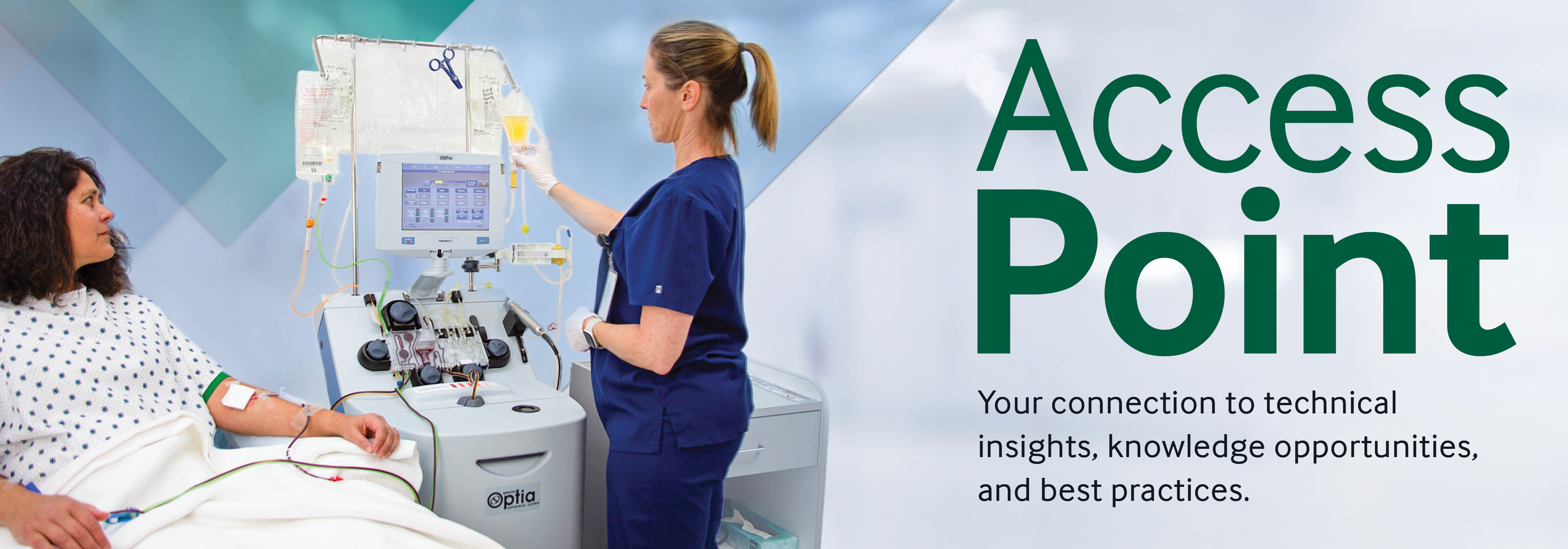
The Access Point newsletter is designed to keep users of the Spectra Optia™ Apheresis System informed and connected with helpful insights and resources to support patient care. If you have questions, comments, or suggestions for future topics, please let us know.
|
|
|
|
|
|
|
What's the difference? Comparing MNC and CMNC protocols
|
|
|
|
Every stem cell therapy starts with a stem cell collection. The quality of that starting material is critical to therapy development and outcomes for patients dealing with certain cancers and other diseases. That’s why Spectra Optia offers two stem cell collection protocols: dual-stage mononuclear cell collection and continuous mononuclear cell collection.
|
|
|
|
|
|
Dear Access Point,
My coworkers and I know that CMNC and MNC follow different procedural steps, use different disposable sets, and use different fillers. Can you explain how Spectra Optia initiates the collection for each procedure?
— Rob from Charlotte, NC
|
|
|
|
Dear Rob,
As you noted, CMNC and MNC are different procedures using different supplies. In both procedures, anticoagulated whole blood enters the centrifuge and is separated into layers (plasma, buffy coat, and red blood cells [RBCs]) through centrifugal force and specific gravity. The plasma and buffy coat are pumped out of the centrifuge, while the RBCs passively exit.
Now let’s look at some key differences.
|
|
|
|
In CMNC
- A low packing factor of approximately 4.5 is used.
- Once the interface is established and the Automated Interface Management (AIM™) System begins detecting cells in the collect line, the collect valve opens.
- Target white cells are continuously pumped into the collect bag until the procedure endpoint is reached.
In MNC
- A higher packing factor of 20 is used.
- Once the interface is established, the chamber begins to fill, signaling the start of the accumulation phase.
- The buffy coat is pumped into the chamber.
- The platelets are continuously pumped to the reservoir, while the MNCs and RBCs remain in the chamber.
- Once the chamber is full, the MNCs exit. As they flow past the RBC detector, AIM opens the collect valve, initiating the collection phase.
- During this phase, the pump flow rates change, the centrifuge speed decreases, and the target cells are flushed from the chamber.
- Next, the centrifuge speed increases, and the MNCs are chased up the collect line past the collect valve with plasma.
- The collect valve closes, and another accumulation phase begins.
- The number of collection phases will depend on the patient’s cell counts and the procedure goals.
|
|
|
|
If you have a specific question about the Spectra Optia system, let us know. We will feature a reader question in each Access Point edition. Be sure to tell us your first name, hometown, and state or province. Questions not featured will be answered directly via email.
|
|
|
|
|
|
|
|
|
|
Did you know?
This collection chamber holds just 6 mL
The collection chamber on the collection set used for the MNC protocol holds approximately 6 mL of cells. Surprised? You might be, since the chamber can take an hour or more to fill, and each collection phase sends 20 mL to the collection bag. But remember, there’s a lot happening in the collection chamber, including a second separation step where platelets are separated and sent back to the patient while MNCs continue to accumulate.
|
|
|
|
Live From Lakewood
Key Insights on the Spectra Optia Apheresis System Version 12.1.1 software | March 19, 2026
All Live From Lakewood sessions are scheduled for 12 p.m. MT. Learn more and register to attend any of these live and interactive webinar sessions from our headquarters in Lakewood, Colorado. If you would like to have a specific topic covered in one of these webinars, please send us an email.
April 22-24, 2026 | Denver, CO
Terumo Blood and Cell Technologies will be holding special events in conjunction with the meeting at our North American headquarters in Lakewood, Colorado. Look for additional information from us and from ASFA as the meeting draws closer.
March 5-7, 2026 | San Diego, CA
Don’t miss this comprehensive 2.5-day multidisciplinary program presented by the University of California San Diego school of Medicine.
|
|
|
|
|
|
You're on the front lines of care, and we're here to assist.
|
|
|
|
|
|
|
|
could help you make the most of your Spectra Optia system and your relationship with
Terumo Blood and Cell Technologies to do even more for your patients.
|
|
|
|
Spectra Optia™ is either a registered trademark or trademark of Terumo BCT, Inc. in the United States and/or other countries. See TerumoBCT.com/Trademarks for details.
Intended Use
The Spectra Optia Apheresis System, a blood component separator, may be used to perform the following therapeutic apheresis, cell collection, and cell processing procedures:
• Therapeutic plasma exchange
• Red blood cell exchange, depletion, and depletion/exchange for the transfusion management of sickle cell disease in adults and children
• Mononuclear cell collection from the peripheral blood
• Granulocyte collection from the peripheral blood
• White blood cell reduction for patients with leukocytosis at risk for leukostasis
• Processing of harvested bone marrow for the purpose of facilitating hematopoietic reconstitution
Sources for “Dear Access Point”:
Terumo Blood and Cell Technologies. Spectra Optia Apheresis System Operator’s Manual. Part no. 1000036875. August 2023.
Terumo Blood and Cell Technologies. Continuous Mononuclear Cell Collection (CMNC) Procedure Training – Version 12, Instructor Handbook. 2025. TS-OPTI-01966.
|
|
|
|
©2026 Terumo BCT, Inc. | All Rights Reserved | TS-OPTI-02833 | TerumoBCT.com
|
|
|
|
|