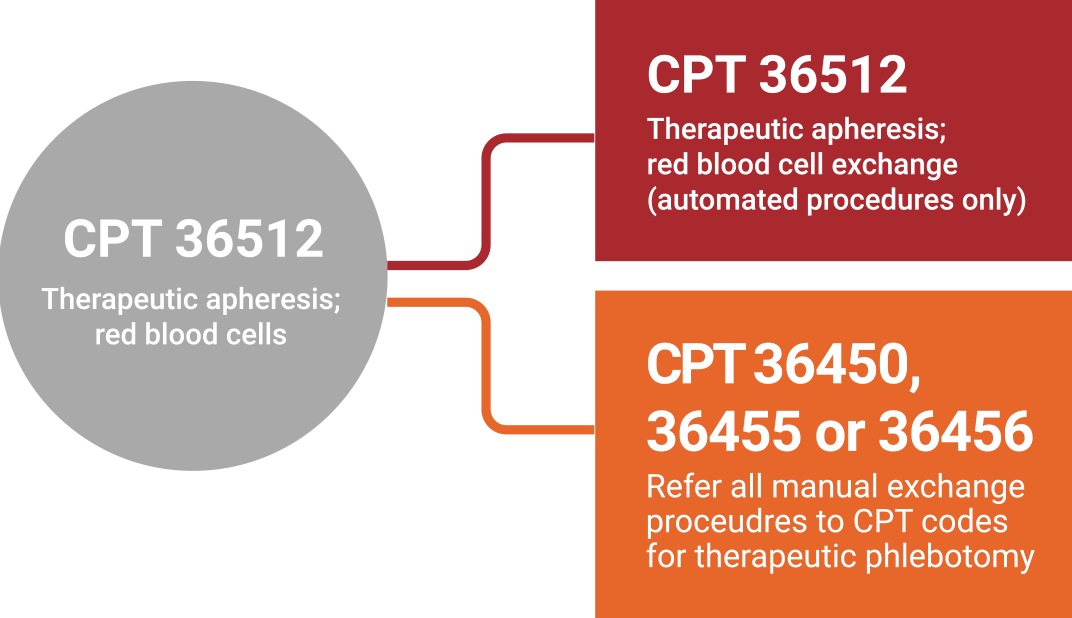
Not all transfusion therapies are the same, and neither is their coding. Starting January 1, 2021, automated red blood cell exchange (RBCX) will have a distinct CPT code. Manual red blood cell exchange procedures will be coded to therapeutic phlebotomy codes. Make sure you are ready for this change in transfusion coding.


Differences in Transfusion Therapies for Patients With Sickle Cell Disease

“I really didn’t find anything that was effective for keeping me away from having crises except for automated RBCX.”

Rona Wiggins, patient with sickle cell disease
Automated RBCX
Procedure code

CPT 36512

Iron-neutral procedure 1

Yes

Procedure time 1

110 minutes

Number of procedures1

8.5 per year

Manual Transfusion Therapies
Procedure code

CPT 36450, 36455 or 36456

Iron-neutral procedure 1

Yes

Procedure time 1

245 minutes

Number of procedures1

12 per year


Reimbursement differs by therapy.
Remember to use the appropriate CPT procedure code for the transfusion therapy that is right for your patient. Effective January 1, 2021, the average Medicare OPPS (Outpatient Prospective Payment System) reimbursement for Automated RBCX will be $1,363.16.2,*


*Terumo Blood and Cell Technologies provides this information for your convenience only. It does not constitute legal advice or a recommendation regarding clinical practice. Information provided is gathered from third-party sources and is subject to change without notice due to frequently changing laws, rules, and regulations. The provider has the responsibility to determine medical necessity and to submit appropriate codes and charges for care provided. Terumo Blood and Cell Technologies makes no guarantee that the use of this information will prevent differences of opinion or disputes with Medicare or other payers as to the correct form of billing or the amount that will be paid to providers of service. Please contact your Medicare contractor, other payers, reimbursement specialists, and/or legal counsel for interpretation of coding, coverage, and payment policies. This document provides assistance for FDA-approved or cleared indications. Where reimbursement is sought for use of a product that may be inconsistent with, or not expressly specified in, the FDA-cleared or approved labeling (e.g., instructions for use or operator’s manual), consult with your billing advisors or payers on handling such billing issues. Some payers may have policies that make it inappropriate to submit claims for such items or related service.



Helpful Resources


2021 Reimbursement Guide   
2021 Medicare coding and national payment rates for outpatient therapeutic apheresis, plus sickle cell disease diagnosis codes.

Red Blood Cell Transfusion: A Pocket Guide for the Clinician   
From the American Society of Hematology (ASH), adapted from Red Blood Cell Transfusion: A Clinical Practice guideline from AABB.

Red Blood Cell Exchange in Patients With Sickle Cell Disease — Indications and Management: A Review and Consensus Report by the Therapeutic Apheresis Subsection of the AABB   
Transfusion. 2018;58(8):1965-1972.

Automated RBC Exchange Compared to Manual Exchange Transfusion for Children With Sickle Cell Disease Is Cost-Effective and Reduces Iron Overload   
Transfusion. 2018;58(6):1356-1362.

Effectiveness of Red Blood Cell Exchange, Partial Manual Exchange, and Simple Transfusion Concurrently With Iron Chelation Therapy in Reducing Iron Overload in Chronically Transfused Sickle Cell Anemia Patients   
Transfusion. 2016;56(7):1707-1715.

Patient Guide   
How automated red blood cell exchange can help you manage the balancing act of sickle cell disease for your patient.


   Myth or Reality — Is automated RBCX costly and inconvenient?
Many apheresis programs offer outpatient automated RBCX programs and peripheral access. Studies have also shown potential for significant savings on a long-term RBCX program.3,4,5

An analysis of 23 patients in the United Kingdom with recurrent vaso-occlusive crises (VOCs) undergoing regular RBCX for one to five years showed that over time, RBCX led to significant cost savings due to reduction in hospital attendance and limited need for costly chelation therapy.5

While you are updating your knowledge on the CPT coding change, learn the myths and realities about automated RBCX.

Download “5 Myths of Treating Sickle Cell Disease With Automated Red Blood Cell Exchange.”


Disclaimer

Terumo Blood and Cell Technologies manufactures apheresis devices that are cleared to perform the transfusion management of sickle cell disease. The codes and diagnoses presented in this guide are not intended to promote the use of Terumo Blood and Cell Technologies’ devices in connection with any specific disease or condition, but rather to provide publicly available, third-party information regarding billing and coding for various common uses of apheresis.

Apheresis-Related Safety Information

Contraindications

Contraindications for the use of apheresis are limited to those associated with the infusion of solutions and replacement fluids as required by the apheresis procedure and those associated with all types of automated apheresis systems.

Adverse events of apheresis procedures can include: Anxiety, headache, light-headedness, digital and/or facial paresthesia, fever, chills, hematoma, hyperventilation, nausea and vomiting, syncope (fainting), urticaria, hypotension, allergic reactions, infection, hemolysis, thrombosis in patient and device, hypocalcemia, hypokalemia, thrombocytopenia, hypoalbuminemia, anemia, coagulopathy, fatigue, hypomagnesemia, hypogammaglobulinemia, adverse tissue reaction, device failure/disposable set failure, air embolism, blood loss/anemia, electrical shock, fluid imbalance and inadequate separation of blood components.6

Reactions to blood products transfused during procedures can include: Hemolytic transfusion reaction, immune-mediated platelet destruction, fever, allergic reactions, anaphylaxis, transfusion- related acute lung injury (TRALI), alloimmunization, posttransfusion purpura (PTP), transfusion-associated graft-versus-host disease (TA-GVHD), circulatory overload, hypothermia, metabolic complications and transmission of infectious diseases and bacteria.7,8

Restricted to prescription use only.

  • Operators must be familiar with the system’s operating instructions.
  • Procedures must be performed by qualified medical personnel.

References

1National Institute for Health and Care Excellence. Spectra Optia for automatic red blood cell exchange in patients with sickle cell disease. Medical technologies guidance (MTG28). https://www.nice.org.uk/guidance/mtg28 . Published March 2016. Accessed 09 April 2019.

2Medicare National Average payment rates, unadjusted for wage. “National Average Payment” is the amount Medicare determines to be the maximum allowance for any Medicare covered procedure. Actual payment will vary based on the maximum allowance less any applicable deductibles, co-insurance etc. See 2021 NPRM OPPS Cost Statistics Files at cms.gov.

3Willits I, Cole H, Jones R, Carter K, et al. Spectra Optia for automated red blood cell exchange in patients with sickle cell disease: NICE medical technology guidance. Appl Health Econ Health Policy. 2017;15:455-68.

4Kelly S, Quirolo K, Marsh A, Neumayr L, Garcia A, Custer B. Erythrocytapheresis for chronic transfusion therapy in sickle cell disease: survey of current practices and review of literature. Transfusion. 2016;56(1):2877-2888

5Tsitsikas D, Ekong A, Berg L, et al. A 5-year cost analysis of automated red cell exchange transfusion for the management of recurrent painful crises in adult patients with sickle cell disease. Transfus Apher Sci. 2017;56(3);466-469.

6Crookston KP. Therapeutic Apheresis: a Physician's Handbook. 5th ed. Bethesda, MD: AABB/ASFA; 2017.

7AABB. Circular of Information for the Use of Human Blood and Blood Components. Bethesda, MD: AABB; 2017.

8European Directorate for the Quality of Medicines & HealthCare (EDQM). Guide to the Preparation, Use and Quality Assurance of Blood Components. 19th edition. Strasbourg, France: EDQM Council of Europe; 2017.


CPT ©2019 American Medical Association. All rights reserved.

CPT® is a registered trademark of the American Medical Association. Applicable FARS/ DFARS Restrictions Apply to Government Use. Fee schedules, relative value units, conversion factors and/or related components are not assigned by the AMA, are not part of CPT, and the AMA is not recommending their use. The AMA does not directly or indirectly practice medicine or dispense medical services. The AMA assumes no liability for data contained or not contained herein.